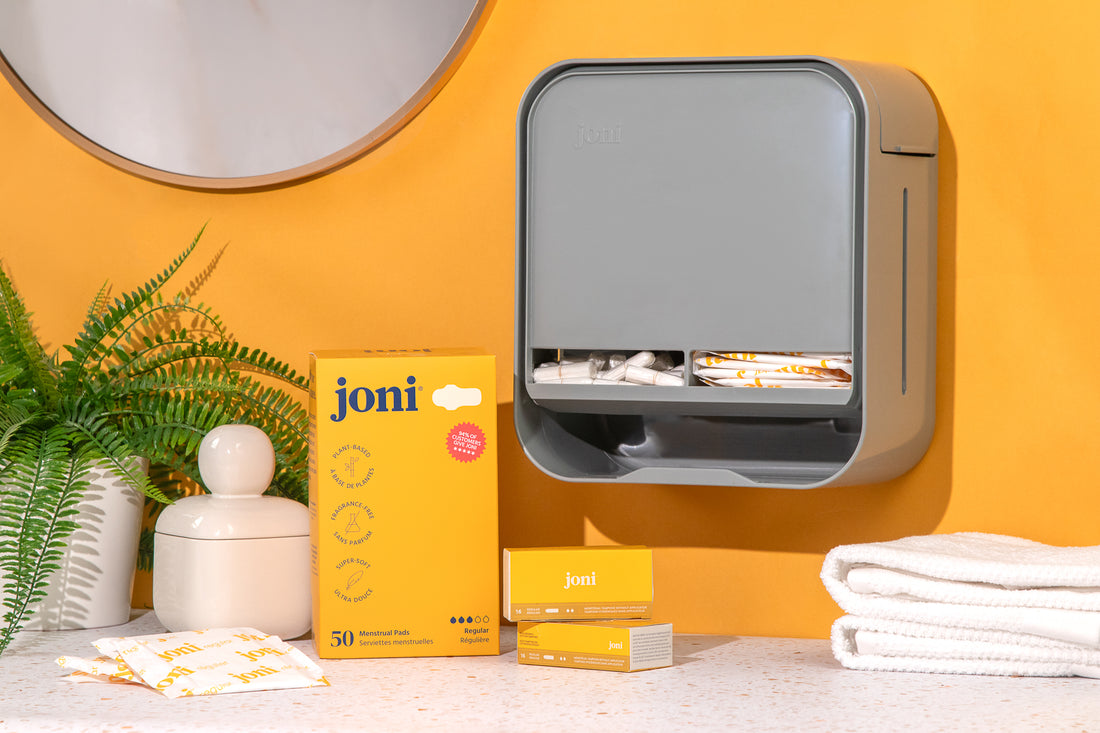

The Students' Society of McGill University (SSMU) offers free pads and tampons across campus using joni Model A free-vend dispensers and compostable products. Within one month of launch, the program was running on a simple, predictable monthly order, with far less packaging waste than retail-boxed products.
Why Campuses Are Acting Now
Free period products are fast becoming an expected campus service, like toilet paper and soap. Four trends are behind the shift:
- Students feel the cost most: 17% of people in Canada who menstruate have experienced period poverty, and 15% say cost has held them back from school, work, or sports (Women and Gender Equality Canada). Among 18 to 24 year olds, 88% say period products are too expensive (NUPGE).
- Free access is becoming the standard: Since December 2023, federally regulated employers in Canada must provide free tampons and pads in every washroom (Canada Labour Code). B.C. has required free products in schools since 2019. Students now arrive on campus expecting the same dignity and access.
- Programs are moving past pilots: Universities are turning single-building trials into campus-wide dispenser networks, and researchers are evaluating real-world outcomes (Health Promotion Practice, 2026). Ongoing running costs and usage rates matter just as much as the initial launch.
- Sustainability goals apply here too: Conventional menstrual pads are commonly estimated to be up to 90% plastic (UBC), and every retail box adds unnecessary waste. A free product program should never compromise a campus's zero-waste or ESG commitments.
The Challenge
SSMU wanted free products in washrooms across a sprawling campus of over 40,000 students. The initiative had to meet four critical benchmarks:
The Solution
SSMU partnered with joni for an end-to-end commercial deployment: dispensers, certified organic/compostable products, and consolidated bulk replenishment from a single Canadian provider.
- joni Model A Free-Vend Dispensers: Acquired outright at $200 less per unit than the legacy commercial fixtures SSMU evaluated, the joni Model A is an open dispenser at an affordable price.
- Sustainable Period Products: High-performance pads and tampons that reduce landfill burden by ~1.5 g per unit compared to plastic-laden retail alternatives.
- Commercial Bulk Packs: Packed in bulk cases (200 pads, 192 non-applicator tampons, or 288 applicator tampons) rather than retail cartons—eliminating thousands of individual consumer boxes to unpack, flatten, and discard.
SSMU launched with 58 bulk case packs across four product lines (~11,500 units total). This baseline rollout provided the exact consumption metrics needed to optimize future deliveries.
| Product Line | Case Packs | Total Units |
|---|---|---|
| Regular Pads | 30 | 6,000 |
| Super Pads | 12 | 2,400 |
| Regular Tampons | 10 | 1,920 |
| Super Tampons | 6 | 1,152 |
| Total | 58 | 11,472 |
The Results
Following the 30-day baseline period, SSMU transitioned to a predictable, scheduled 30-day recurring replenishment order of 41 cases (~8,400 units).
| Product | Case Packs / 30 Days | Total Units |
|---|---|---|
| Regular Pads | 16 | 3,200 |
| Super Pads | 12 | 2,400 |
| Regular Tampons (Non-Applicator) | 5 | 960 |
| Super Tampons (Non-Applicator) | 5 | 960 |
| Tampons with Applicator | 3 | 864 |
| Total | 41 | 8,384 |
Operational & Sustainability Impacts
| Metric | Launch Order | Monthly Order | Annualized Impact |
|---|---|---|---|
| Retail Packaging Diverted | 99 kg | ~70 kg | ~835 kg |
| Direct Landfill Burden Avoided | ~17 kg | ~12.6 kg | ~150 kg |
How to Compare Dispenser Programs
Hardware acquisition costs represent only a fraction of lifetime program expenditures. Refill formats, lock-in vendor contracts, and constituent materials dictate total operating expense and ecological impact. Facility teams can benchmark potential partners against these standards:
| Evaluation Criteria | The joni Solution at McGill | Questions to Ask Any Provider |
|---|---|---|
| Dispenser Cost | Owned outright; saved $200/unit compared to commercial alternatives | Is the dispenser a purchase or an ongoing lease? What is the total installed cost per washroom? |
| Refill Format | Bulk custodial packs; zero individual retail consumer boxes | Does the hardware require proprietary cartridges? What is the net cost per individual product? |
| Vendor Commitment | Single supplier with flexible recurring orders calibrated to demand | Are dispensers locked behind multi-year service or restocking contracts? |
| Product Materials | Certified organic, compostable pads and tampons | What are the items made of, and what percentage of plastic do they introduce? |
| Product Flexibility | Full mix: Regular/Super pads, digital and applicator tampons | Can replenishment cases be adjusted as actual washroom traffic patterns evolve? |
| Impact Reporting | Calculated packaging waste and landfill savings per delivery | Does the vendor deliver auditable metrics for annual campus ESG / sustainability reports? |
Bring It to Your Campus: 5 Steps
McGill's sustainable framework can be replicated across any university, college, or student union: